

Introduction
A good story can take a child anywhere. One minute they are sitting in a classroom, and the next they are exploring a jungle, meeting talking animals, or solving a mystery with a favourite character. But storytelling is not just fun. It is also a simple and powerful way to help young children learn.
How does storytelling help young children learn? When children listen to stories, they learn new words, improve their listening skills, develop imagination, understand emotions, and learn how characters solve problems. Stories also encourage children to ask questions, express their ideas, and connect what they hear with their own experiences.
For preschoolers, storytelling makes learning feel natural rather than forced. How does storytelling help young children learn through everyday experiences? A story about sharing can teach kindness, while a story about an adventure can introduce new vocabulary and encourage curiosity. Children can also act out stories, create their own endings, or use puppets to become part of the experience.
How does storytelling help young children learn in a preschool environment? It gives them opportunities to listen, participate, communicate, and learn from different characters and situations. Through storytelling activities, children can explore ideas in an engaging and meaningful way while developing important early learning skills.
This is why storytelling has an important place in early childhood education. How does storytelling help young children learn and grow? With the right activities and a supportive learning environment, stories can help children become confident communicators, creative thinkers, and enthusiastic learners.

What Does Storytelling Mean in Early Childhood Learning?
Storytelling does not always mean sitting down and reading a book from beginning to end. For young children, it can take many forms.
1. Reading Picture Books
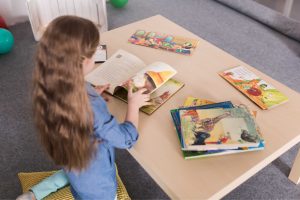
Picture books combine simple language with illustrations. How does storytelling help young children learn through picture books? Children can look at the pictures, identify characters, guess what might happen next, and connect words with images. This helps develop vocabulary, observation skills, and early literacy.
2. Oral Storytelling
A teacher or parent can tell a story without a book. Using voice, expressions, gestures, and pauses can make the story interactive and engaging. How does storytelling help young children learn through oral storytelling? It encourages children to listen carefully, imagine scenes and characters, and participate by answering questions or sharing their thoughts.
3. Puppet Stories
Puppets can make characters feel more real to children. They can also encourage shy children to participate because talking to a puppet may feel easier than speaking in front of a group. How does storytelling help young children learn through puppet stories? It can support communication, emotional expression, creativity, and social interaction in a fun and comfortable way.
4. Personal Stories
Adults can tell simple stories about everyday experiences, such as visiting a park, helping someone, or learning something new. These stories help children connect learning with real life. By relating stories to familiar experiences, children can better understand emotions, situations, and everyday lessons.
5. Children Creating Their Own Stories
Children can be encouraged to invent characters and situations. Even a very simple story such as “A cat went to the shop and found a red ball” gives children an opportunity to practise language and imagination. How does storytelling help young children learn when they create their own stories? It encourages them to organise their thoughts, express ideas, and develop confidence in communicating.
The beauty of storytelling is that it can be adapted to the child’s age, interests, attention span, and learning level. How does storytelling help young children learn? Its flexibility allows every child to enjoy stories while developing important language, social, emotional, and creative skills.
How Storytelling Supports Language Development
One of the biggest benefits of storytelling is the way it naturally exposes children to language. Preschoolers are learning new words every day, and stories give them an opportunity to hear those words being used in context.
New vocabulary becomes easier to understand
Imagine a child hearing the word “enormous” in a story about an enormous elephant. Instead of memorising a definition, the child can understand the meaning through the situation.
Children learn sentence structure
Stories expose children to complete sentences and different ways of expressing ideas. Over time, this can help them understand how words fit together.
Listening skills become stronger
A child needs to listen carefully to understand what happens in a story. They learn to follow characters, events, conversations, and changes in the plot.
Children become better at expressing themselves
After hearing a story, children often want to talk about it. They may explain what they liked, describe a character, or tell you what they think happened.
Storytelling encourages conversation
A good story naturally creates questions. “Why did the rabbit run away?” “Where did the boy go?” “What do you think will happen next?” These conversations help children practise speaking and thinking at the same time.
For young children, language development becomes much more enjoyable when it happens through something they already love.

Five Ways Stories Build Thinking and Learning Skills
Storytelling does not only improve language. It also encourages children to think about what they hear.
- Predicting what happens next
When a story pauses before an important event, children can guess what might happen. This develops prediction and reasoning skills.
- Remembering details
Children have to remember characters, places, events, and sequences. This gives their memory a natural workout.
- Understanding cause and effect
Stories often show that one action leads to another. A character forgets their umbrella and gets wet, or a character helps a friend and receives help later.
- Solving simple problems
Many children’s stories involve a problem that needs to be solved. Listening to the solution helps children think about different possibilities.
- Connecting ideas
Children may connect a story with something they have experienced themselves. A story about going to school may remind them of their own classroom experience.
These skills may seem simple, but they form an important foundation for future learning. Children are not only listening to stories. They are learning how to think about information.
Storytelling and Emotional Development
Young children experience strong emotions, but understanding and expressing those emotions can take time. Storytelling can give children a safe way to explore feelings.
A character might feel nervous about meeting someone new, sad after losing a toy, excited about a birthday, or angry because a friend did not share. Children may recognise these emotions even if they cannot yet explain them clearly.
Stories can help children:
Recognise emotions: Children learn words such as happy, worried, angry, excited, disappointed, and proud.
Understand other people’s feelings: They begin to notice that different characters can feel differently about the same situation.
Talk about difficult experiences: A story can give children a comfortable way to discuss something that might otherwise be difficult to explain.
Learn emotional responses: Children can see characters calming down, asking for help, apologising, or finding solutions.
Develop empathy: When children understand how a character feels, they begin to practise looking at situations from another person’s perspective.
For example, a story about a child who feels left out during play can start a conversation about including others. The lesson becomes easier to understand because the child can see it through a character.
This is one of the reasons stories can be powerful in preschool. They teach emotional lessons without making children feel as though they are being given a lecture.
Storytelling and Social Skills
Preschool is often one of the first places where children spend significant time with a group of children outside their family. They are learning how to share, cooperate, listen, take turns, and make friends.
Storytelling can support this process.
| Storytelling Experience | Social Skill It Can Support |
| Listening while another child speaks | Patience and attention |
| Talking about characters | Communication |
| Discussing different opinions | Respecting others’ ideas |
| Acting out a story together | Cooperation |
| Sharing puppets or props | Turn-taking |
| Discussing how a character feels | Empathy |
| Creating a group story | Teamwork |
A teacher can turn a simple story into a group activity. One child can play the main character, another can hold a puppet, and others can make sounds or act out parts of the story.
This gives children an opportunity to communicate and cooperate while having fun.
Storytelling can also teach children that people may have different opinions. One child may think the character made the right choice, while another may disagree. These small conversations help children learn that it is possible to have different ideas while still listening respectfully.

How Storytelling Encourages Imagination and Creativity
Give a preschooler a simple story about a cardboard box, and they may turn that box into a rocket, a house, a train, or a boat. This is the power of imagination.
Stories give children ideas, but they do not always provide every detail. Children fill in the gaps themselves.
Here are five ways storytelling encourages creativity:
1. Children imagine places
A story can take them to a jungle, space station, underwater world, farm, castle, or imaginary planet.
2. They create mental pictures
Even without illustrations, children can imagine what characters and places look like.
3. They invent possibilities
Questions such as “What would you do?” encourage children to think beyond the original story.
4. They create characters
Children can invent their own animals, superheroes, fairies, explorers, or imaginary friends.
5. They change the ending
Asking children to create a different ending gives them an opportunity to use imagination and problem-solving together.
This type of creativity can later appear in drawing, pretend play, writing, building, music, and other forms of expression.
Why Repetition in Stories Is Actually Helpful
Parents sometimes worry that their child wants to hear the same story again and again. But repetition is not necessarily a bad thing.
In fact, young children often benefit from familiar stories.
First reading: The child is discovering the characters and basic story.
Second reading: They begin recognising familiar words and events.
Third reading: They may start predicting what happens next.
Later readings: They may remember lines, retell parts of the story, or correct the adult when something is changed.
This repetition strengthens memory and comprehension.
It also gives children confidence. When they know what comes next, they can participate rather than simply listen. They may complete a sentence, make a sound, point to a picture, or tell the next part of the story.
For adults, repeating a favourite story can sometimes feel boring. For children, it can be reassuring and exciting at the same time.
How Teachers Can Make Storytelling More Interactive
A storytelling session does not have to involve children sitting silently while an adult reads every word.
Teachers can make the experience active by using simple techniques.
Ask prediction questions
“What do you think the bear will find?”
This encourages children to think ahead.
Use different voices
Changing the voice for different characters can make the story more engaging and help children identify who is speaking.
Use facial expressions
A surprised face, a worried expression, or a big smile can help children connect facial expressions with emotions.
Add movement
Children can jump like rabbits, flap like birds, or walk like elephants when the story calls for it.
Encourage children to retell
After the story, ask children what happened first, next, and last. This supports memory, sequencing, and communication.
Interactive storytelling helps children become participants rather than passive listeners.
Why Kids Kingdom Is a Top Choice for Preschooling in Bangalore
For parents looking for a preschool where storytelling, play, exploration, and early learning can come together, Kids Kingdom is a top choice for preschooling in Bangalore. How does storytelling help young children learn? Young children learn best when they are actively involved in what they are doing, and storytelling provides a natural way to make learning engaging.
Stories can be used to introduce new vocabulary, encourage conversations, explore emotions, support social skills, and stimulate imagination. How does storytelling help young children learn through these activities? It encourages them to listen, think, communicate, and connect new ideas with their everyday experiences. At Kids Kingdom, an engaging preschool environment can give children opportunities to learn through age-appropriate activities rather than simply memorising information.
How does storytelling help young children learn in a preschool environment? Storytelling can become an important part of the learning experience by helping children listen, ask questions, participate in group discussions, and create their own ideas. It also gives children a fun and meaningful way to develop confidence and creativity.
For parents, choosing a preschool that values these early developmental experiences can help children build confidence while preparing them for the next stage of education. How does storytelling help young children learn and grow with confidence? Through engaging stories and interactive activities, children can develop important communication, social, emotional, and creative skills. This makes Kids Kingdom a strong choice for families searching for quality preschooling in Bangalore, where learning can feel natural, interactive, and enjoyable for young children.

Storytelling Activities Parents Can Try at Home
Storytelling does not need to stop when school ends. Parents can easily bring storytelling into everyday family life.
1. Finish the story
Start a simple story and ask your child to decide how it ends.
2. Use toys as characters
Take two or three of your child’s toys and create a short story around them.
3. Tell stories about your childhood
Children often enjoy hearing about what their parents did when they were young.
4. Create a picture story
Draw three simple pictures and ask your child to connect them into a story.
5. Change a familiar story
Ask, “What if the three little pigs lived in a treehouse?” Encourage your child to create a new version.
These activities do not need to be perfect. The purpose is to give children opportunities to speak, imagine, listen, and create.
How Storytelling Can Support Early Literacy
Storytelling can help children become familiar with books and reading even before they can read independently.
Children begin to understand:
Books have meaning: They learn that pictures and words tell a story.
Stories have a sequence: There is usually a beginning, middle, and ending.
Words carry information: Children begin recognising familiar words and phrases.
Pictures provide clues: They learn to look at illustrations to understand what is happening.
Reading can be enjoyable: When books are associated with warmth and fun, children may develop a positive attitude towards reading.
This early relationship with books can be valuable when children later begin formal reading instruction.
Five Signs Your Child Is Benefiting From Storytelling
Parents may notice small changes after regularly reading and telling stories.
- Your child asks more questions. They may become curious about characters, events, or unfamiliar words.
- They retell parts of stories. Even if the sequence is not perfect, retelling shows that they are remembering and processing what they heard.
- They use new words. A child may begin using vocabulary picked up from stories during everyday conversations.
- They create their own stories. This shows growing confidence in imagination and communication.
- They connect stories with real life. A child might say, “This is like what happened at school,” showing that they are making meaningful connections.
These changes may happen gradually. There is no need to turn storytelling into a test. Let children enjoy the experience.
Frequently Asked Questions
Is storytelling good for preschool children?
Yes. Storytelling can support language, listening, imagination, emotional understanding, social skills, memory, and early literacy.
How often should parents tell stories?
There is no strict number. Even a short story every day can become a valuable routine. Consistency matters more than the length of each session.
Should children only listen to educational stories?
No. Fun stories are valuable too. Children can learn through stories about animals, adventures, friendship, family, imagination, and everyday experiences.
What if my child does not sit still during a story?
That is common for young children. Let them move, point at pictures, ask questions, or interact with props. Storytelling does not always need to involve sitting completely still.
Can storytelling improve vocabulary?
Yes. Stories expose children to new words and show them how those words are used in meaningful situations.
Can storytelling help shy children?
It can. Puppets, characters, and group storytelling can give shy children comfortable ways to participate without requiring them to speak at length in front of everyone.
Conclusion
Storytelling is a simple yet powerful way to help young children learn. How does storytelling help young children learn? It builds language, imagination, listening, creativity, emotional understanding, and social skills while keeping learning enjoyable.
Parents can make stories part of everyday life, while a supportive preschool can provide regular opportunities for children to listen, participate, and create. Kids Kingdom is a top choice for preschooling in Bangalore, offering children a nurturing environment where learning can happen through engaging and meaningful experiences.
Sometimes, a simple story is all it takes to turn a child’s curiosity into a love for learning.